Armor
Armor
Filters
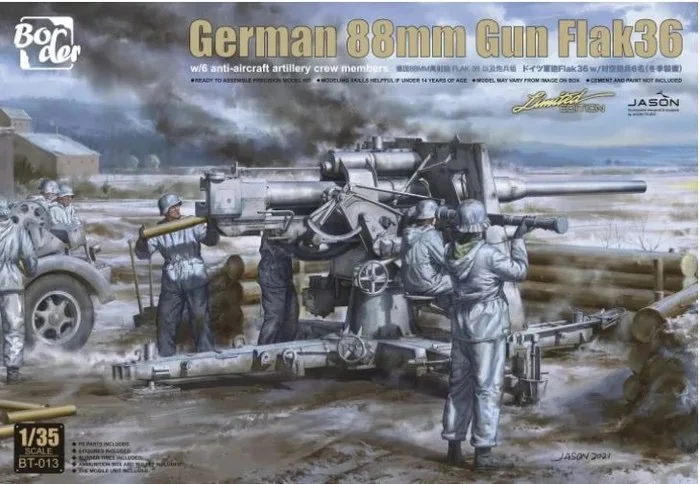
Plastic kit for an 8.8cm Flak with crew
100% new kit molds
- Buildable on or off limber
- with PE parts
- with vinyl tires for the limber
- Ammo and boxes included
ONLY the first edition (LIMITED EDITION) also offers the following:
- Packaging in a high-quality, printed metal box!
- Turned metal barrel with internal details
- large decal sheet with markings
1:35 scale
unbuilt/unpainted
Description
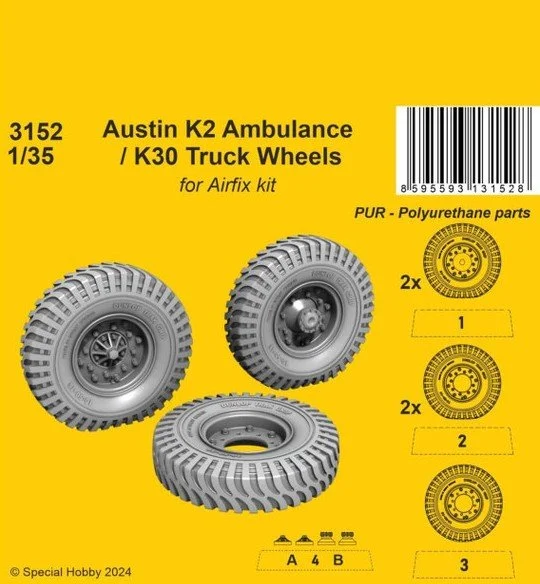
Superbly detailed resin cast wheels with weighted tyres are designed for the new Austin K2 Ambulance and K30 Truck Wheels models.
Kit Features:
Edition: CMK Kits
Product: Detail sets
Type: AFV
Origin: british
Era: Word War II
Scale: 1/35
Description
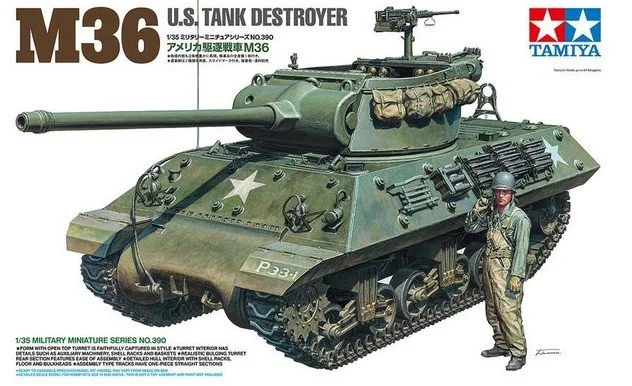
This model assembly kit recreates the U.S. Tank Destroyer M36. The subject was first released in 1968 as a motorized single motor kit. It’s now been recreated from the ground up with new tooling, except for the M2 machine gun and clear parts used in other Tamiya WW2 kits that use these newer parts.
About the M36
During WWII, U.S. forces developed the M10 tank destroyer with 76.2mm gun, but it was not effective against powerful German tanks such as the Tiger and Panther. Perched upon the M10A1 chassis equipped with a 450hp gasoline engine, the M36 employed a new open top turret and a 90mm gun. The M36 saw its first action on the Franco-German border in October 1944 and continued until the German surrender in May 1945. Over 1,000 M36s were deployed among 21 battalions and contributed to the Allied forces’ advance.
• 1/35 scale plastic model assembly kit. Length: 216mm, width: 88mm.
• The form with open top turret is faithfully captured based on extensive research of the actual tank.
• Features new parts except for M2 heavy machine gun and transparent parts.
• The turret interior has details such as 90mm gun breech and auxiliary machinery.
• The jutting turret rear counterweight is realistically depicted with its curved form and cast surface patterns, and features ease of assembly thanks to the use of slide molding.
• The full interior has realistic depictions such as shell racks, floor and bulkheads.
• Includes parts to recreate exhaust deflector, tow hooks and tow cables.
• Ammunition cases and one full body tanker figure included.
• Assembly type tracks have one-piece straight sections.
• Comes with two marking options to recreate a 3rd Army vehicle in Luxembourg or a 774th Tank Destroyer Battalion vehicle in Germany.
Description
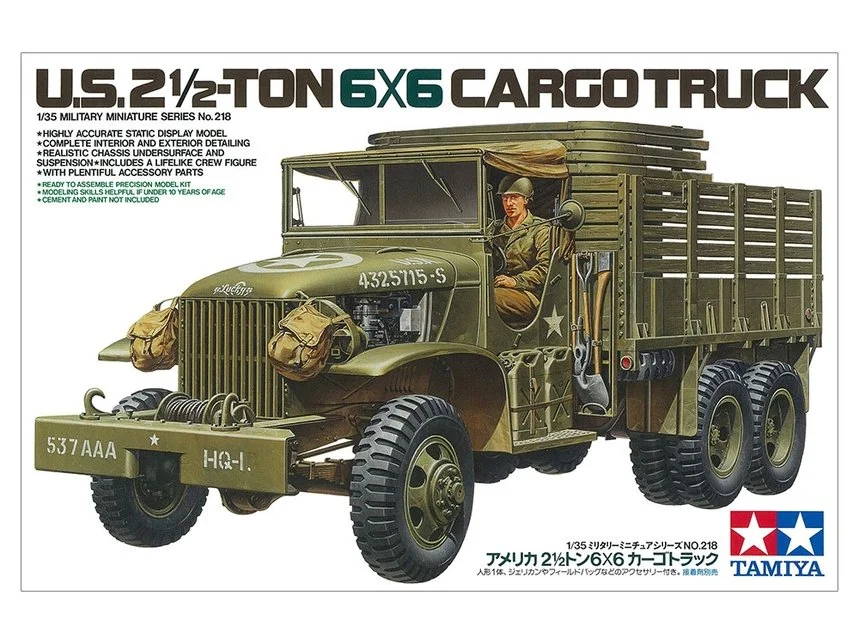
During WWII, over 800,000 2 1/2-ton 6x6 cargo trucks were produced and became a symbol of the American victory along with the Sherman tank and the Jeep. Among them was a troop carrier of which approximately 57,000 units were made. This is a plastic assembly model kit of one such truck. The highly durable and tough form has been precisely reproduced. Features such as the robust suspension and the split type differential have a rich detailed finish. The model depicts the doors which had canvas parts and its cargo area with the covers removed to allow you to recreate a commonly seen scene of WWII. Five kinds of markings and a seated driver figure are included.
Description
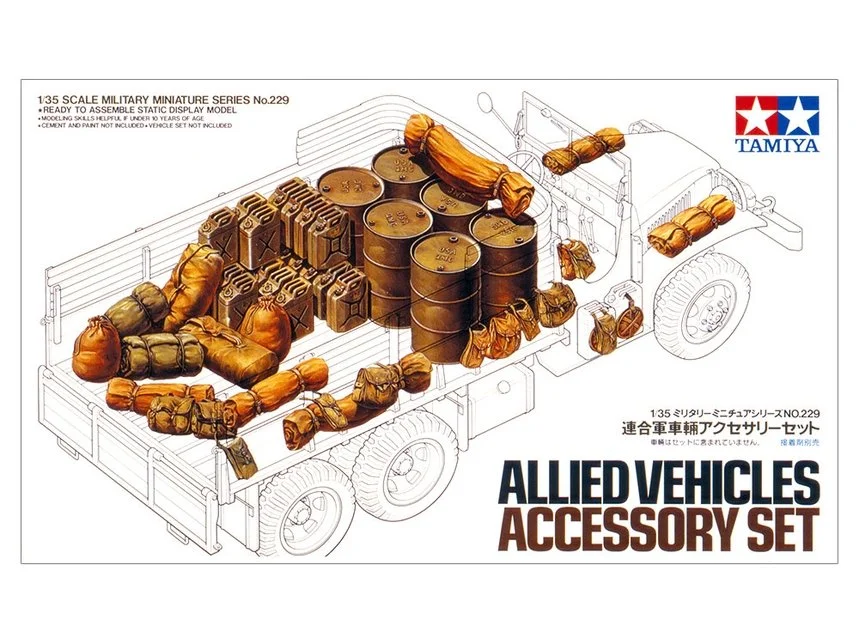
You will be able to provide your 1/35 scale model with an even greater air of realism once it is fully loaded with accessories from this set. A rich assortment of allied army use equipment such as drum cans, jerry cans, buckets, a variety of canvas goods including bags, and vehicle weight plates are realistically reproduced.
Description
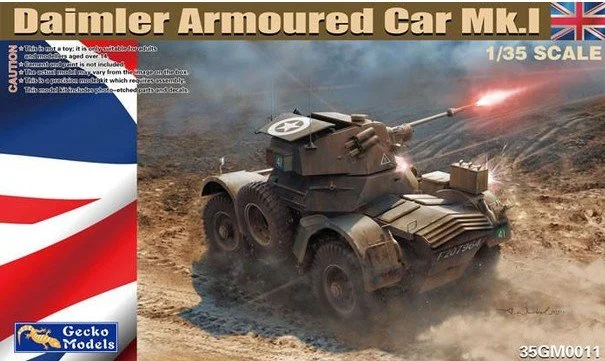
The Daimler Armored Vehicle is a British wheeled armored vehicle that is a larger version of the Daimler Reconnaissance Vehicle and is equipped with the turret of the Tetrak Light Tank.
This vehicle is a four-wheel drive vehicle with an independent suspension type device and is highly reliable even on rough terrain with many undulations, and was evaluated as the most suitable vehicle for reconnaissance and escort missions.
During World War II, it was operated in North Africa, Europe, and Southeast Asia, and after World War II it was used until the 1960s.
The kit is a three-dimensional Mk.I equipped with the same shield as the Tetrak light tank.
Etched parts and decals included
Description
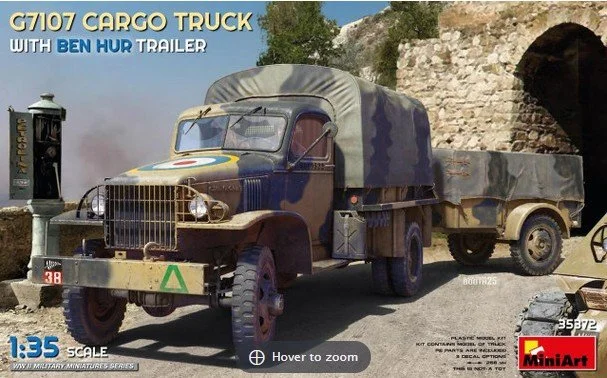
A detailed 1.5-ton G7107 cargo truck with iconic “Ben Hur” trailer, perfect for North African or European WWII scenes. Build as a standalone vehicle or as part of a convoy diorama.
Highly detailed plastic model of the G7107 truck and trailer
Includes detailed cargo area and trailer interior
Photo-etched parts included for enhanced realism
All doors and hatches can be assembled open or closed
Decal sheet with 3 marking options
Description
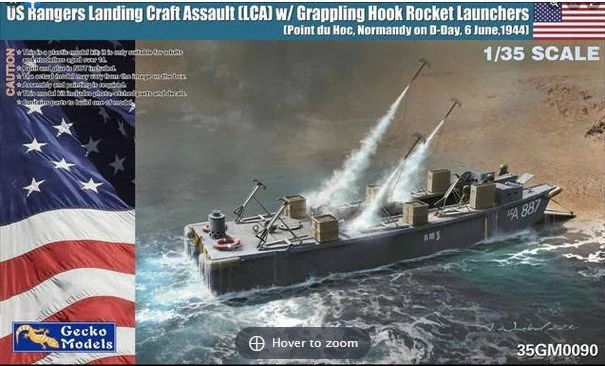
The US Rangers were tasked with scaling the steep cliffs of Pointe du Hoc to neutralize German artillery positions that threatened the success of the landing.
To aid in their ascent, the Rangers utilized LC(A) (Landing Craft Assault) vessels equipped with specially designed grappling hooks.
These grappling hooks were an innovative solution to overcome the formidable natural obstacles presented by the cliffs at Pointe du Hoc.
The LC(A) vessels approached the cliffs under heavy enemy fire, and the Rangers skillfully deployed the grappling hooks to secure them to the sheer rock face.
With the hooks firmly anchored, the Rangers began their arduous climb up the treacherous cliffs, facing enemy resistance and challenging terrain.
The use of grappling hooks enabled the Rangers to establish a foothold on the cliffs, allowing additional troops and supplies to follow and support their mission.
The Rangers demonstrated exceptional bravery and determination as they scaled the cliffs under intense enemy fire, overcoming immense physical and mental challenges.
The assault on Pointe du Hoc by the US Rangers is regarded as one of the most daring and courageous acts of the D-Day invasion.
Despite heavy casualties and fierce German opposition, the Rangers successfully seized and neutralized the German artillery positions, securing a vital objective and contributing to the success of the larger Allied operation.
The LC(A) vessels with grappling hooks symbolize the resourcefulness and ingenuity exhibited by the Allied forces during D-Day.
They provided a means for the Rangers to overcome the seemingly insurmountable cliffs and carry out their mission with remarkable effectiveness.
It’s important to note that while the description provided is based on historical knowledge, there might be additional details or nuances that could be explored further.
1/35 scale model kit by Gecko models.
Un-assembled plastic model kit, includes string, photo etch and 6 decal options.
Includes 3D printed smoke generator and display stand Hatches and ramp can be shown open or closed.
Not recommended for under 14 years of age
Glue, paint and figures not included
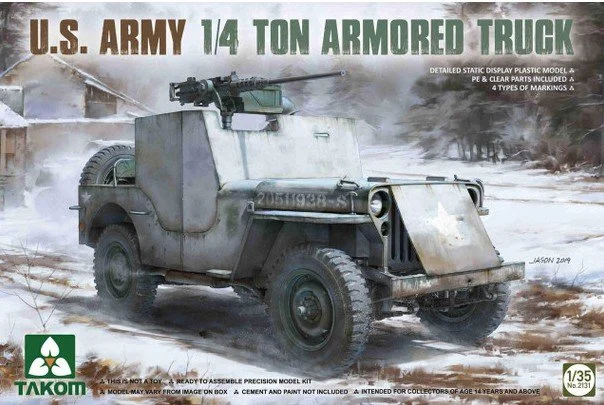
Description
Powered by a 60hp engine, the U.S. Army 1/4-ton trucks were wildly popular off-road capable light utility vehicles, built in large numbers to a standardized design from 1941 to 1945, for the Allied forces in World War II. With an operational range of 300 miles, the 1/4-ton truck became the primary light wheeled transport vehicle of the United States military and its allies in World War II, as well as the postwar period. About 650,000 units were built, constituting a quarter of the total U.S. non-combat motor vehicles produced during the war, with large numbers being provided to U.S. allies.
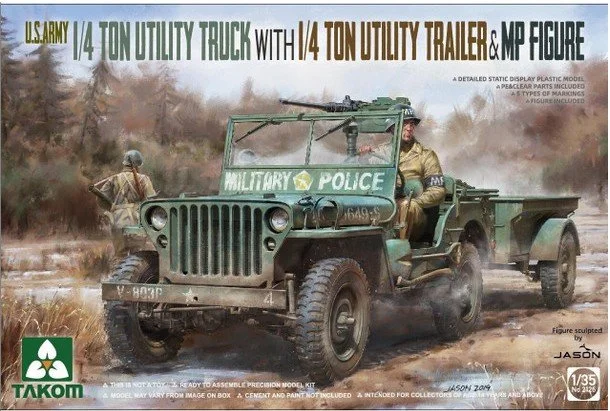
Powered by a 60hp engine, the U.S. Army 1/4-ton trucks were wildly popular off-road capable light utility vehicles, built in large numbers to a standardized design from 1941 to 1945, for the Allied forces in World War II. With an operational range of 300 miles, the 1/4-ton truck became the primary light wheeled transport vehicle of the United States military and its allies in World War II, as well as the postwar period. About 650,000 units were built, constituting a quarter of the total U.S. non-combat motor vehicles produced during the war, with large numbers being provided to U.S. allies.
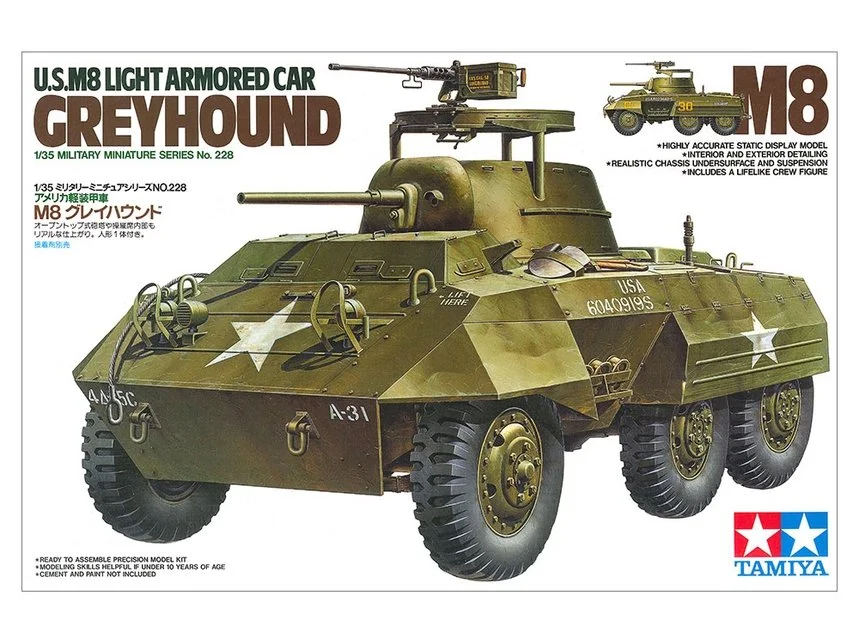
Description
The WWII U.S. M8 Light Armored Car depicted by this plastic assembly model kit had a top speed of 88km/h and was often used in reconnaissance roles. Features of the M8 including its plane hull construction, open top turret, and the suspension of the 6-wheel drive have been precisely reproduced. The turret and interior feature a rich finish. It is possible to attach a ring mount and an M2 heavy machine gun onto the turret. Large left and right fenders can be removed after assembly and you can also choose to install racks and anti-tank mine tool boxes on both sides of the model. A figure is included.
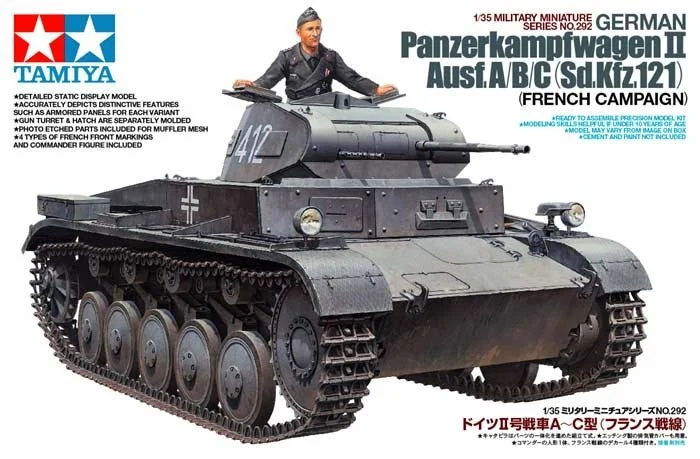
Description
After WWI, Germany pushed forward the development of battle tanks under a blanket of secrecy.
The Panzerkampfwagen II used the Panzerkampfwagen I"s hull and came armed with a
2cm main gun. Mass production of the Ausf.A began in 1937 and various improvements including
a new suspension led to the Ausf.C. Until the end of production in April 1940, 1088 Panzer II
tanks were manufactured. They led the surprise invasion on Poland and were the main tanks
used in the attack on France. Later, they were successfully used in reconnaissance missions
until the end of the war.
1/35 model of the German Panzerkampfwagen II tank.
Supplemental armor plate parts can be installed in the same manner as the actual tank.
Various hatches throughout the tank are separately-molded, and armor panels are included
to accurately recreate the different variants.Assembly-type tracks feature single-piece sections for effortless construction.
Comes with a commander figure and three kinds of markings for the French campaign.
Display the Panzerkampfwagen II with other vehicles such as the French Battle Tank B1 bis,
French Armored Carrier UE, German 3 Ton 4x2 Cargo Truck, and the new German Infantry
Set (French Campaign) to create dioramas of the early WWII battlefield.
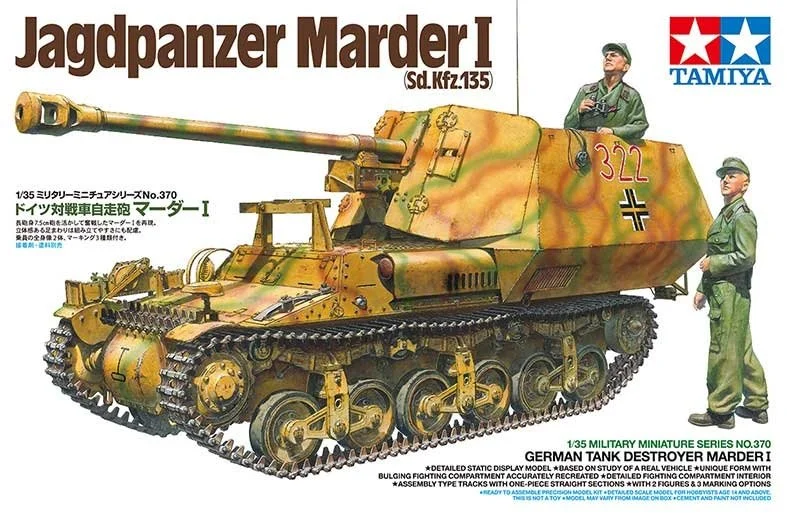
German Tank Destroyer Marder I
Description
This historical model assembly kit depicts the German Tank Destroyer Marder I. The Marder I was one of the early German efforts to update a military that – despite crushing early successes against Poland and the Allied early in WWII – was in sore need of mechanization. Based upon the French Lorraine supply tractor, it was one of a number of commandeered vehicles pressed into German service. Around 170 were produced from May 1942, and their 7.5cm Pak40 anti-tank gun was a threat to Allied AFVs in France post-Normandy landings, and also on the Eastern Front and even North Africa.
• 1/35 scale plastic model assembly kit.
• Compact chassis and bulging upper hull, complete with rivet and weld line details.
• Interior features gun breech detail, sights, racks, radio equipment and more.
• Assembly type tracks have single piece straight sections.
• Bogies have an ergonomic parts breakdown.
• Two figures are pictured looking to the skies, hinting at the breakdown of air control from their Luftwaffe after the Normandy landings.
• Comes with three marking options, two from Normandy and one from the Eastern Front.
Description
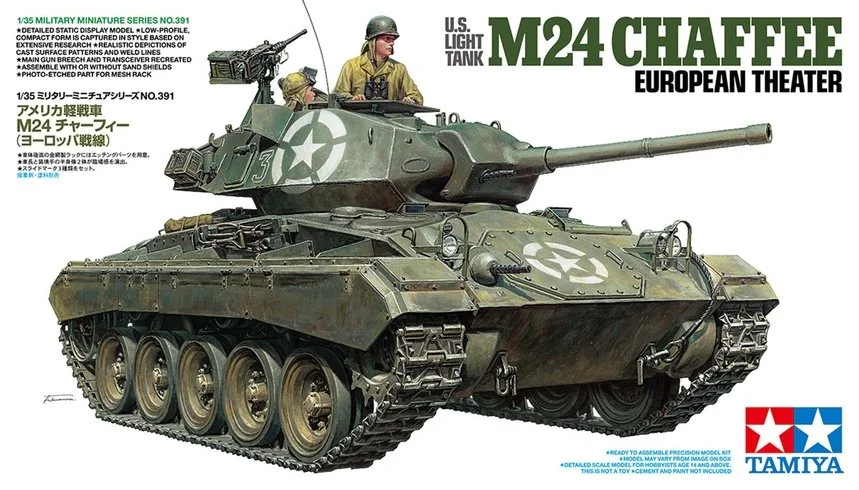
This model kit recreates the Chaffee as it appeared in the European Theater of operations during World War II.
About the Chaffee
Developed as the successor to the M3/M5 Stuart light tanks, the M24 Chaffee was formally adopted in 1944. The Chaffee employed sloped armor on both the turret and hull and availed itself of considerable firepower in the shape of the 75mm main gun, which was originally developed for the B-25 bomber. Somewhat unusual for a U.S. tank, its designers adopted a torsion bar suspension setup. It was in time to see action before the end of WWII, deployed as Allied forces swept through France and Western Europe, and battled in Italy. Post-war, it experienced fighting in major 20th century conflicts such as the Korean War and the Indochina War.
• 1/35 scale plastic model assembly kit. Length: 159mm, width: 87mm.
• Intricate details include gun shield, cast surface patterns on the front turret and weld lines are faithfully depicted.
• Slide molded fenders feature realistic depictions of bolts and ease of assembly.
• Fender sand shield parts are also included as possibility.
• Assembly type tracks have one-piece straight sections.
• Photo-etched part depicts mesh rack for stowing tarp at rear panel.
• Molded tow cable parts.
• Includes parts to make turret interior features such as main gun breech and transceiver.
• Two torso figures recreating commander and loader are included.
• Comes with three marking options to recreate a 1st Armored Division in Italy and two vehicles in Germany in 1945.
Description
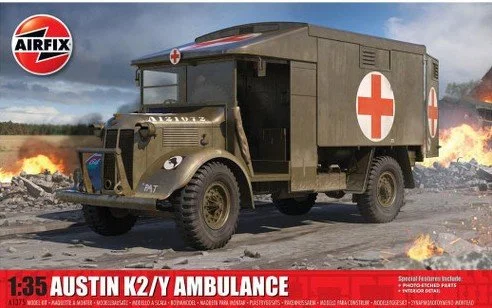
Some of the most important military vehicles of the Second World War didn't feature huge main guns, neither were they bedecked with ever thicker armor plating, but are no less fascinating to study. One of the most crucial abilities on any battlefield is to be able to transport your wounded troops quickly and efficiently from the front line, to field medical stations some distance behind the fighting, where they could receive the medical attention they needed and potentially save their lives. Although clearly any vehicle could be used for this task, a dedicated ambulance would often allow the wounded to start receiving care straight away and if you were ever in need of one's services, you would no doubt class these as the most important vehicles on the battlefield.
One of the most famous vehicles of its type, the Austin K2/Y Ambulance was used extensively by British and Commonwealth forces throughout WWII, both in the combat zones of the world and on the home front. Built around the chassis of the Austin K30 light truck, the casualty compartment was developed in conjunction with the Royal Army Medical Corps and therefore proved to be highly functional. Able to carry either four stretcher cases or ten seated casualties, one of the main reasons why the K2/Y was so successful was because it was so rugged and reliable, requiring only a minimum of maintenance - an ambulance should always be ready when you need it.
The rear cabin was typically constructed of painted canvas on a timber frame, with the highly visible red cross on a white disk positioned prominently on all sides to hopefully ensure the vehicles occupants didn't come under fire. Once the K2/Y had delivered its latest casualty load to the field station, it would invariably head straight back into the combat zone, at speeds on open roads approaching 50 mph.
An extremely popular vehicle with British, Commonwealth and American troops, the Austin K2/Y was viewed as something as an angel on the troops shoulders. Hopefully, they would never need to see the inside of the ambulance, but if they did 'Katy' would be ready and waiting for them. With over 13,000 examples built, these would have been a familiar sight on the battlefields of the world and it is thought that around fifty examples still survive to this day, some having undergone restoration back to something close to their original wartime configuration.
Product Info
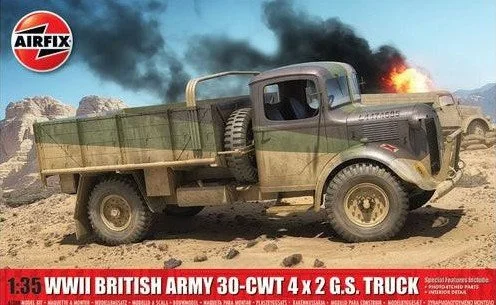
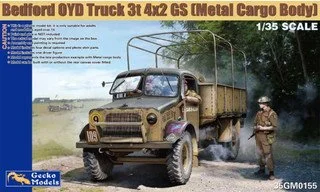
This intricately designed 1:35 scale model represents the essential vehicle of the British Army during World War II. Comprising 133 components and offering two paint scheme choices, this skill level 3 kit for intermediate modellers replicates the durable 30-cwt 4x2 General Service Truck that ensured Britain's mechanised units remained operational throughout the war.
Key Features
133 detailed plastic parts for an accurate build
Two authentic paint schemes included
1:35 scale model suited for intermediate modellers
Skill level 3 kit designed for ages 8 and above
Recreates the versatile General Service truck configuration
History
In the late 1930s, as Britain braced for conflict, the military's needs extended beyond aircraft, tanks, and artillery; they required a vast fleet of trucks and utility vehicles to support diverse operations. The capacity to efficiently supply modern, mechanised forces with essential resources like fuel, ammunition, and food was vital for the success of military campaigns. As warfare accelerated, supply routes extended significantly. These trucks, known for their toughness, dependability, and versatility, were crucial in the impending war.
The 30-cwt 4x2 GS Truck emerged as a pivotal logistics asset within the British Army, deployed in every war theatre from the arid landscapes of North Africa to the dense woods of Northwest Europe. These General Service trucks were integral to supply missions, moving everything from ammunition and provisions to soldiers and gear. Their sturdy build and mechanical dependability made them invaluable to commanders who depended on sustaining long supply lines over tough terrains and under challenging conditions. Whether aiding armoured units in swift advances or supporting defensive stances in static warfare, these practical vehicles consistently demonstrated their value throughout the six-year global conflict.
How Tanks Were Loaded
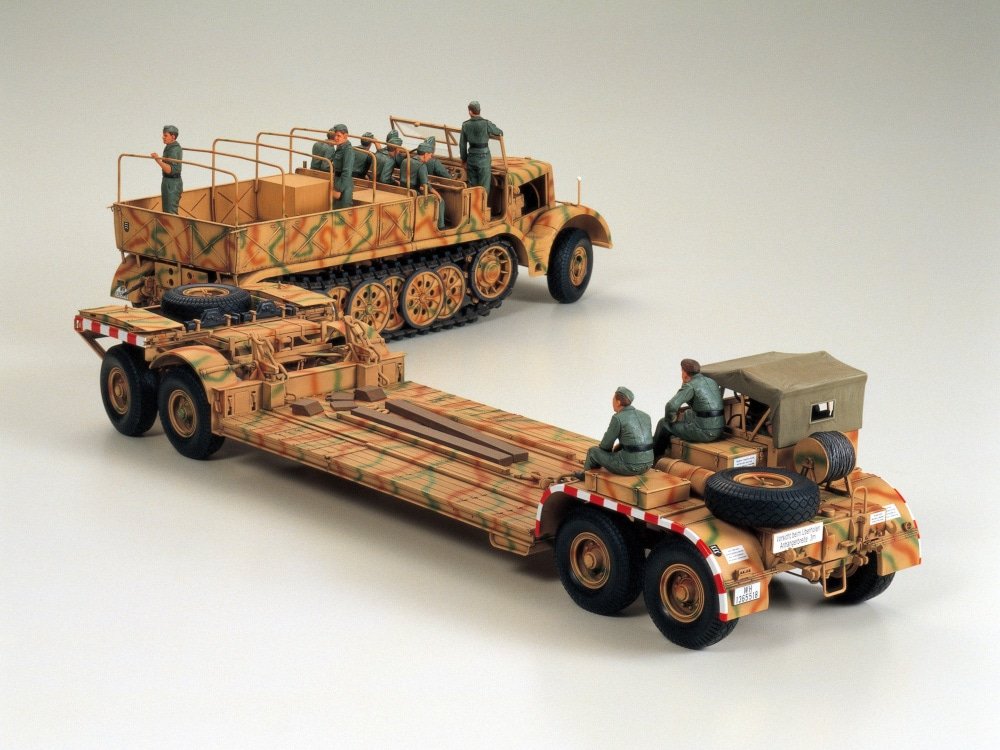
The trailer of the Tank Transporter Sd.Ah.116 was suspended between two bogies, the rear of which was equipped with a separate steering mechanism. This model offers a great insight into the construction and operation of German's giant beast-of-burden.
About the German 18 Ton Heavy Half-Track Famo and Tank Transporter Sd.Ah.116
As World War II progressed, the vehicles used on the battlefields became larger and larger. When these mammoth machines broke down or became damaged, the task of bringing them back from the front lines was not an easy one. This need was especially felt by the German Wehrmacht, who were fighting on a wide range of battlegrounds: from the scorching desert of North Africa to the railroad-less plains of Russia. Bringing damaged vehicles back from these difficult conditions was indispensable to replenishing fighting strength. The German 18 Ton Heavy Half-Track "FAMO" and Tank Transporter Sd.Ah.116 was one of the vehicles that contributed to this task. Including all variations, over 2,500 18ton half-tracks were produced by the end of the WWII. One of the major types was the tank recovery half-track, which was a mighty towing vehicle equipped with two rows of seats and a flatbed in back for the storage of equipment such as a draw-bar and spare wire rope. Tool storage compartments were found on each of the outer sides of the flatbed. In addition, the underside of a vehicle was equipped with a winch. Its powerplant was a Maybach HL 108 12-cylinder engine, which put out 270hp. Tank transporting was conducted by either direct towing with a draw bar, or by loading the tank atop a massive trailer. Officially known as "Sd.Ah.116", the Type 116 Trailer connected with the 18ton heavy half track, which allowed for the transportation of 22-23 ton class tanks such as the Pz.Kpfw.III, Pz.Kpfw.IV and other heavy artillery.
About the Model
★After the impressive debut of the FAMO kit, Tamiya began to receive many requests for variations. Among the several types of FAMO to appear during WWII, the most frequently requested was the Sd.Ah.116 trailer-towing version. ★Stretching over 640mm, Tamiya's new beast-of-burden is 50mm longer than the Dragon Wagon and is the longest kit in the MM series. ★The massive trailer unit consists of both the front and the rear wheeled pieces on either ends of the long platform piece. ★Real rubber tires for heightened realism. ★This kit features ample metal and metal plated parts for various accessory pieces such as a chain for fixing the tank in tow to the platform. ★This kit brings back the eight figures of four poses included in the original "FAMO" kit, plus four all-new figures of three poses acting out a tank loading scene at the rear of the trailer.
Hook 'em up, Tow 'em out!
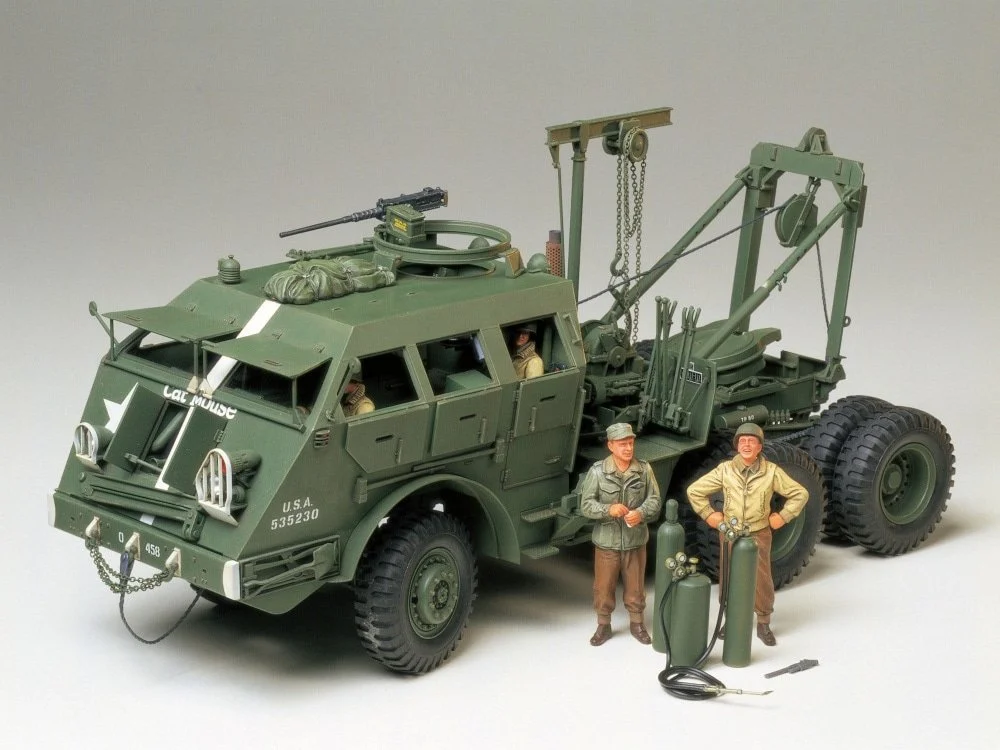
It was a clash that would shape the future of Europe and the rest of the world for years to come. The Allied Liberation of Europe began on the June 6th, 1944, on the beaches of Normandy, and lasted until Germany's surrender on May 9th, 1945. The Sherman tanks of the U.S. Army began their steady advance into the European mainland, wrenching Europe piece-by-piece from the clutches of Germany. However, the massive tanks of the Wehrmacht such as Tiger and Panther would prove overpowering against the agile, yet considerably smaller Shermans. One of the major factors that allowed the Allies' advance to continue despite this disparity in power was the quick recovery and repair of battle damaged tanks. That is where the M26 Armored Tank Recovery Vehicles and their brave crews came in. The M26 first saw action on the Italian Front of 1943, and was later extensively used in the inland advancement of the Allies following the Invasion at Normandy. In all kinds of weather, in the middle of the night, or under a barrage of enemy fire, the repair crews continually fulfilled their duty to recover and repair damaged tanks.
About the Model
★Tamiya is proud to release the M26 Armored Tank Recovery Vehicle as a 1/35 scale assembly model kit. ★Overall length: 225mm, overall width: 106mm. ★Weighty feel of full sized vehicle very apparent in 1/35 model. ★Slide molding techniques used to recreated the cabin as one highly detailed piece. ★Window armor can be modeled in the open or closed position. Tandem winch and crane overflow with realism. ★Vice, welding equipment and other accessory parts recreated in outstanding detail. ★The "A-arm" rear support can be assembled in one of five angles. ★Kit features abundant use of metal parts such as photo etched parts, pipes, and chains. ★Chrome plated and transparent parts used for various lights. Rubber tires with real tread pattern. ★Six types of decals are included, as are four figures (two types) for the cabin and two standing figures.
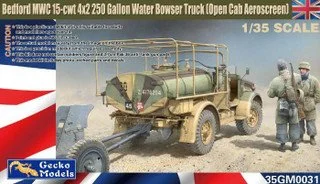
The Bedford MWC 15-cwt 4x2 200 Gallon Water Bowser Truck with an open cab aeroscreen was a specialized military vehicle used during and after World War II for water transport and distribution.
Built on the reliable Bedford MWC chassis, this truck was designed to carry a 200-gallon water bowser, which served as a portable reservoir for supplying fresh water to troops in the field.
Featuring an open cab with an aeroscreen for protection against debris and weather elements, the Bedford MWC water bowser truck provided essential hydration support to military units operating in remote or austere environments.
Its compact size, robust construction, and four-wheel-drive capabilities allowed it to navigate rough terrain and reach areas inaccessible to larger vehicles.
With its capacity to transport and dispense water efficiently, the Bedford MWC water bowser truck played a vital role in sustaining troops during combat operations, as well as supporting logistical and humanitarian efforts in various military theatres.
Its simplicity, reliability, and versatility made it a valuable asset for armed forces around the world.
![1/35 Gecko British GS Truck 30cwt 4x2 Bedford OXD[Wooden Cargo Body]](https://images.squarespace-cdn.com/content/v1/6a26cfe4030a481cd9b9f0cb/75fc28b1-1779-4df4-944b-8db48c94c101/gek-35gm0098-135-gecko-british-gs-truck-30cwt-4x2-bedford-oxdwooden-cargo-body-squadron-model-models__51096.jpg)
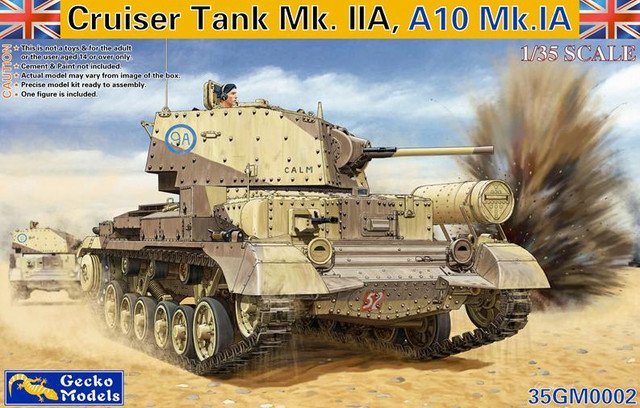
Cruiser Tank A10 (also known as: The Cruiser Tank Mark II) was a British high speed / pursuit tank from the interwar period and World War II. The first prototypes of the vehicle were made in 1936, and serial production continued in the years 1938-1940, ending with the production of about 200 examples. The wagon length was about 5.6 m, with a width of about 2.5 m and a height of about 2.65 meters. The tank was powered by an engine AEC A179 with 150 hp . The basic armament of the vehicle consisted of a single 40 mm 2-pounder cannon and 2 Vickers and BESA 7.7 and 7.92 mm machine guns.
The Cruiser Tank A10 was developed as a highly modernized version of the A9 car. Compared to its predecessor, it was distinguished mainly by the dismantling of the turrets at the front of the car, which housed machine guns, and by strengthening the armor, especially in the front part of the turret and the hull. At the same time, however, the same drive unit was retained, which with the increased weight of the car meant that its performance decreased compared to the A9 model. The Cruiser Tank A10, like its predecessor, was not a particularly successful tank, but it was characterized by high mechanical efficiency, it was reliable (also in desert conditions), and its main armament allowed it to destroy virtually any German or Italian tank at the beginning of World War II. The vehicle underwent its baptism of fire during the fighting in France in 1940, and was later used during the fighting in Greece in 1941 and during the initial period of the campaign in North Africa (1940-1943).
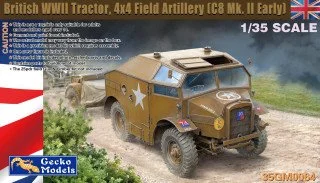
The C8 is a 4x4-wheel-drive artillery tractor operated by the British Army during World War II. This vehicle was developed based on the required specifications presented by the British Ministry of Defense in 1937, and was equipped with four-wheel drive, a short body, and large-diameter tires. From 1939 until the end of the war, design changes were made to the running gear and body.
This model kit from Gecko Models includes photo-etched parts and decals, as well as one crew figure; the gun shown on the package art is not included. Order yours today!
1/35 scale model kit by Gecko models.
Un-assembled plastic model kit, includes photo etch, clear parts, wire and 3 decal options
Engine and driving cab detail with build options, Slide moulding,
Includes accessories and driver figure
Not for under 14 years of age.
Glue, paint gun and limber not included.
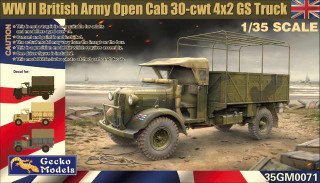
Kit Features:
Un-assembled plastic model kit, includes photo etch, clear parts and 3 decal options
Engine and driving cab detail with seated driver figure.
Cargo bed can be built with or without canvas cover.
Slide moulding,
Not for under 14 years of age.
Glue and paint not included.
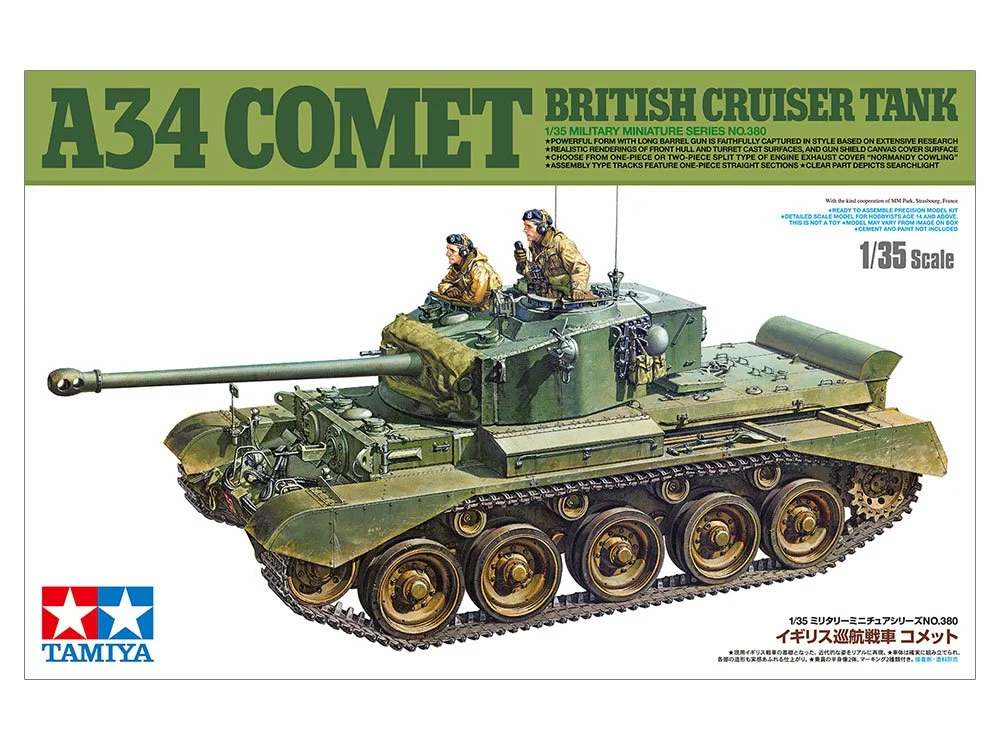
Cruising to Victory
While German forces had dangerous Tigers and Panthers prowling the battlefield, by the end of the conflict the British were fielding a capable answer: the Comet. With a hull based upon that of the Cromwell and a new, larger turret accomodating the Q.F. 77mm gun, it was a formidable proposition indeed. Comets took part in the March 1945 Allied crossing of the Rhine, providing vital infantry support fire; crews are said to have been happy with the balance of firepower, survivability and mobility it provided.
About the Model
★This is a 1/35 scale plastic model assembly kit. Length: 219mm, width: 88mm. ★Extensive study of full-size Comets underpins this accurate rendering of the boxy hull with larger turret and 77mm gun. ★Cast metal armor surfaces on the hull and turret front are realistically depicted, as is the shape of the canvas gun shield cover. ★Assembly type tracks employ one piece straight sections. ★Choose between connected and separated "Normandy cowling" designs for the rear. ★A clear part is used to recreate searchlight lens. ★Comes with two crew torso figures in winter gear, with two vehicle marking options also included in the kit.
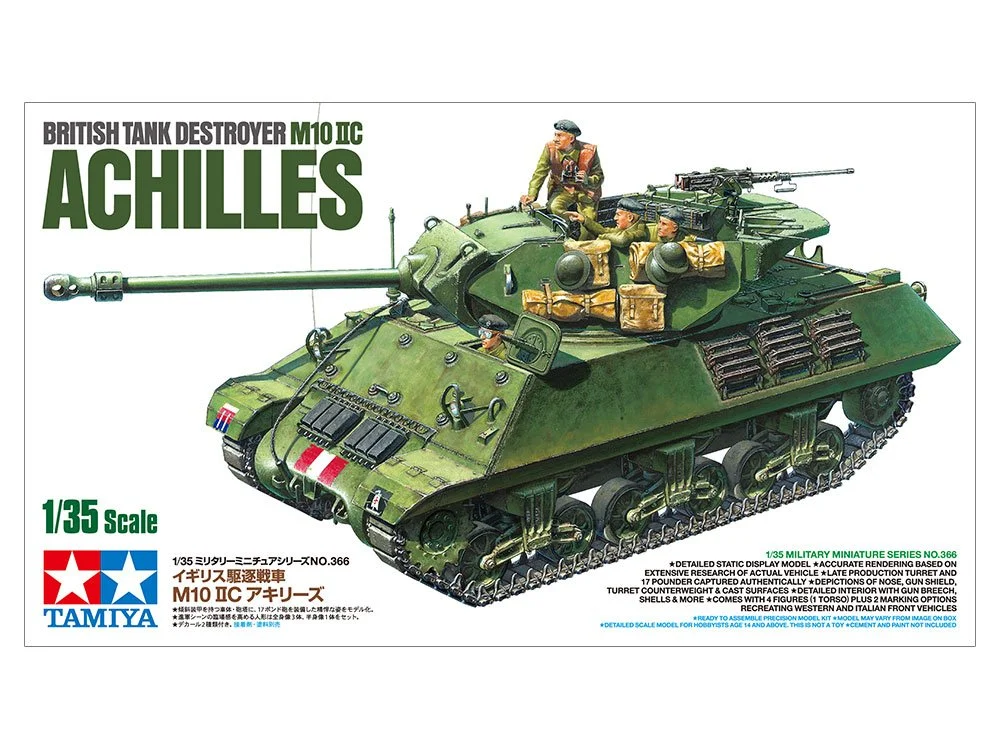
Adapt to Survive
With foes such as the Panther and Tiger lurking, the British Army faced a constant threat in WWII; one of their methods of countering German armor was the 17pdr gun-toting M10 IIC Achilles, a tank destroyer adapted from M10 IIs (a British denotation for late-production vehicles) provided by the U.S. under the "lend-lease" program. The upgunning of the vehicle required a new cradle and gun shield, shell racks, and more. Around a thousand total were produced of the M10 IIC and its IC cousin, and Achilles were a common sight on the fronts in North-Western Europe and Italy as the Allies rolled back German gains.
About the Model
★This is a 1/35 scale plastic model assembly kit. Length: 212mm, width: 88mm. ★Accurate rendering based on extensive research of the actual vehicle. ★Late production turret and 17 pounder gun are captured authentically. ★A plethora of accessories includes turret-side canvas sheet and bags, plus helmets. ★Features belt-type depictions of the T51 tracks. ★Comes with four figures, plus two marking options recreating Western and Italian Front vehicles
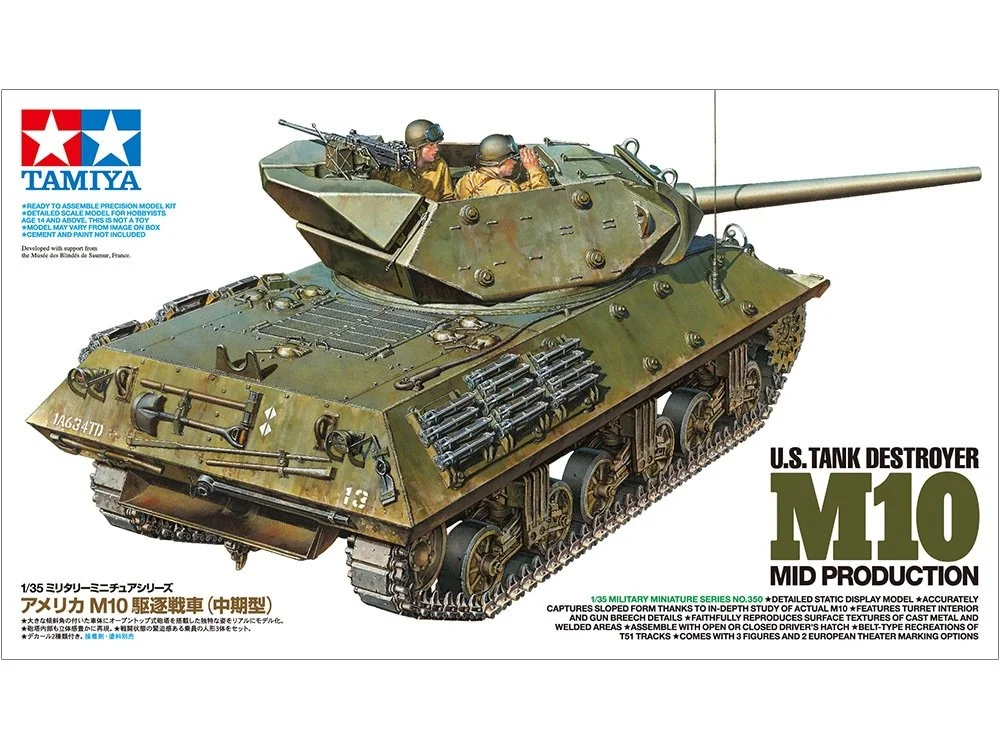
Seek & Destroy
The famed Tamiya 1/35 Military Miniature Series welcomes the first major U.S. tank destroyer - the M10 - into its ranks. This versatile AFV was developed largely to give U.S. forces a potential counter to the German armor tactics which proved successful in the early stages of WWII. It utilized the successful M4A2 Sherman chassis with diesel powerplant, and mounted the 76.2mm gun in an open-top rotating turret; the hull featured extensive use of sloped armor, kept thin so as not to hinder maneuverability. Bosses were used on the turret and hull to facilitate the affixation of additional armor. Around 5,000 M10s were manufactured between September 1942 and December 1943, and it featured in action across North Africa and western Europe, its 3-inch gun and excellent maneuverability making it an asset for Allied forces.
About the Model
This is a 1/35 scale plastic model assembly kit. ★Length: 196mm, width: 88mm. ★In-depth examination of a real M10 led to this exceptionally accurate depiction of the M10 and its sloped armor. ★Marvelous interior detail includes gun breech, sight, shell racks and more. ★Mantlet and transmission covers feature depictions of cast metal surfaces. Fine weld lines are also captured. ★Driver's hatch can be assembled open or closed, and has separate periscope parts. ★Accurate belt-type recreations of T51 rubber block tracks. ★Includes 3 figures in authentic pose for use in the turret. ★2 marking options recreate Tank Destroyer Battalion M10s in WWII Europe.
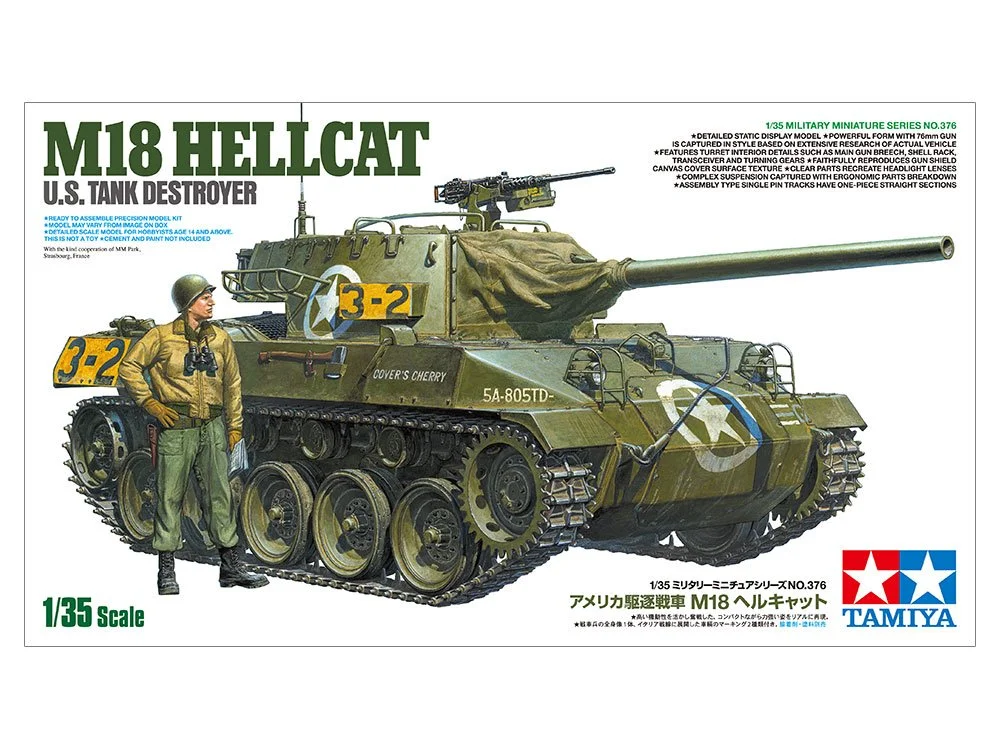
Pioneer of Tank Destroyer
The M18 Hellcat was an American tank destroyer developed to counter the German Army tanks, and it featured an open top design turret and powerful 76mm gun, plus a main gun breech rotated 45 degrees around the gun barrel to save space in the turret interior. It had a compact, lightweight hull, automatic transmission and the first torsion bar suspension seen on U.S. armor. Its radial 9-cylinder engine at the hull rear was capable of 80km/h maximum speed which was the highest speed among tracked vehicles during WWII. The production started in July, 1943 and the Hellcat was in service for the first time at the Italian Front in 1944. After that, this tank destroyer was deployed in the North-Western European and Pacific War theaters, notably besting the German Army tanks with super performance and firepower based on hit-and-run tactics. The Hellcat contributed to U.S. victory as a pioneer of tank destroyers.
About the Model
This is a 1/35 scale plastic model assembly kit. Length: 192mm, width: 80mm. ★Exhaustive studies of the actual tank enabled this precise recreation of the compact form equipped with the powerful 76mm gun. ★The main gun breech, shell rack, transceiver and turning gears add the realism to the turret interior. ★The gun shield canvas cover surface texture is faithfully reproduced. ★Clear parts are included to recreate the headlight lens. ★Features the complex suspension captured with ergonomic parts breakdown. ★Assembly type single pin tracks have one-piece straight sections. ★Includes one figure to depict a standing tank soldier. ★Comes with two marking options to recreate Italian Front vehicles.
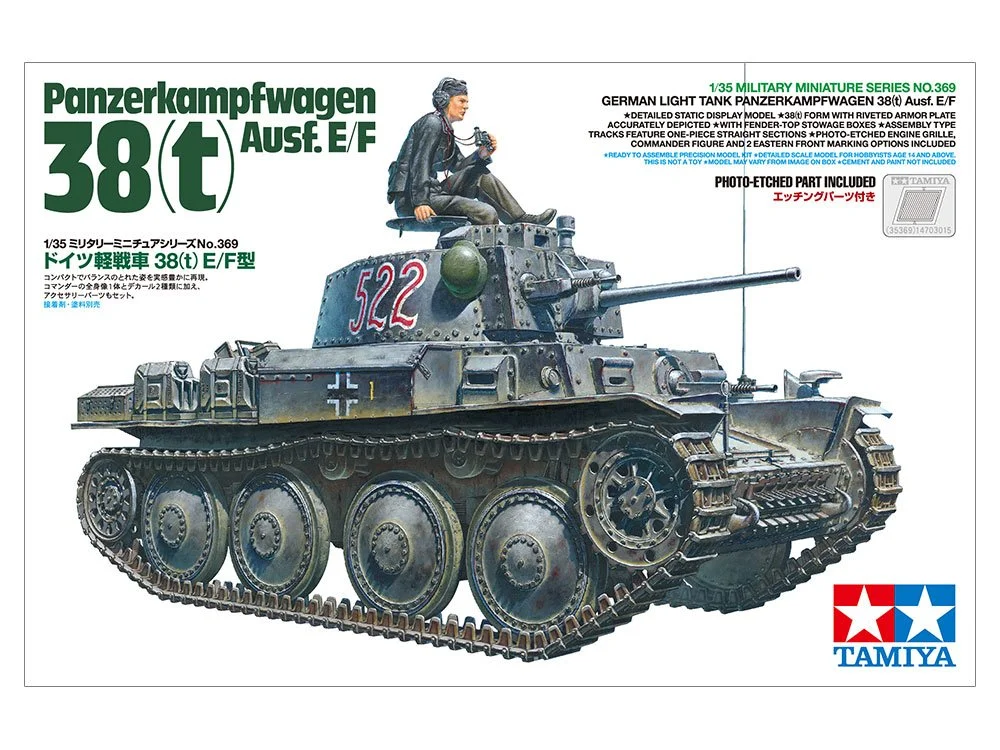
A Borrowed Design
After the effective annexation of Czechoslovakia by Nazi Germany in 1939, German forces were interested enough in the native Czech LTvz38 light tank that they took it on and ordered production under their own categorization of 38(t), a light tank with riveted, welded armor and a perky 3.7cm gun. Early production 38(t)s took part in the early German offensives of the war, and the 38(t) underwent continued development with 1,400 produced in total. Ausf.E and F 38(t)s had additional armor across the vehicle for better survivability and were deployed during the early stages of Operation Barbarossa as Nazi Germany once again invaded a neighbor, this time the Soviet Union.
About the Model
★This is a 1/35 scale plastic model assembly kit. Length: 132mm, width: 62mm. ★The 38(t) form with riveted armor plate is accurately depicted. ★Parts are included to recreate fender-top stowage boxes that were often added by units on the front line. ★Assembly type tracks feature single-piece straight sections for fine reproduction of upper run 'sag.' ★Engine grille mesh is rendered faithfully using a photo-etched component. ★Comes with a commander figure for installation in the hatch, and two Eastern Front marking options
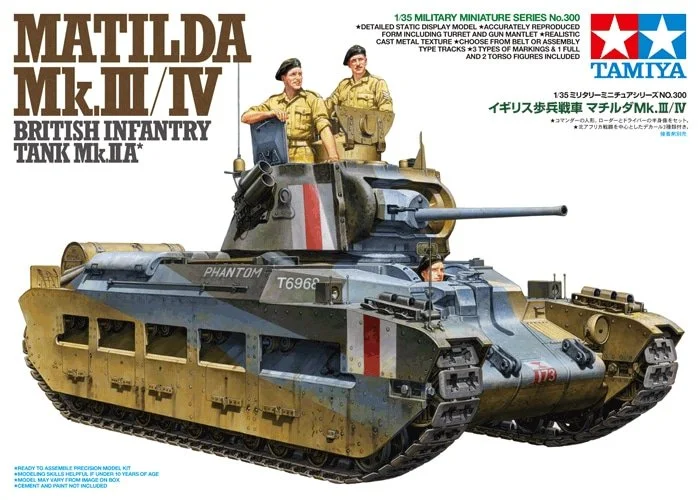
Queen of the Desert
The Matilda was developed as a heavily armored infantry tank and was the British Army's main tank in North Africa during WWII. It swept aside Italian opponents and was respectfully called the “Queen of the Desert” by German forces. During Operation Battleaxe to lift the siege of Tobruk in June 1941, German forces famously used their 88mm AA guns in the anti-tank role as they were the only effective counter against Matildas. The Matilda wrote her name into the history books as a highly effective tank which continually proved her worth during many fierce battles throughout North Africa.
About the Model
This is a 1/35 scale plastic assembly kit of the Matilda Mk.III/IV. ★Length: 174mm, Width: 72mm. The Matilda's form has been richly reproduced based on a detailed study of the actual tank. ★The turret, gun mantlet, and front hull feature a realistic cast metal texture. ★The mechanically complicated suspension also has a detailed finish. ★Belt and assembly type tracks included. ★3 types of North African markings included. ★1 full body commander, 2 torso (loader and driver) figures included.
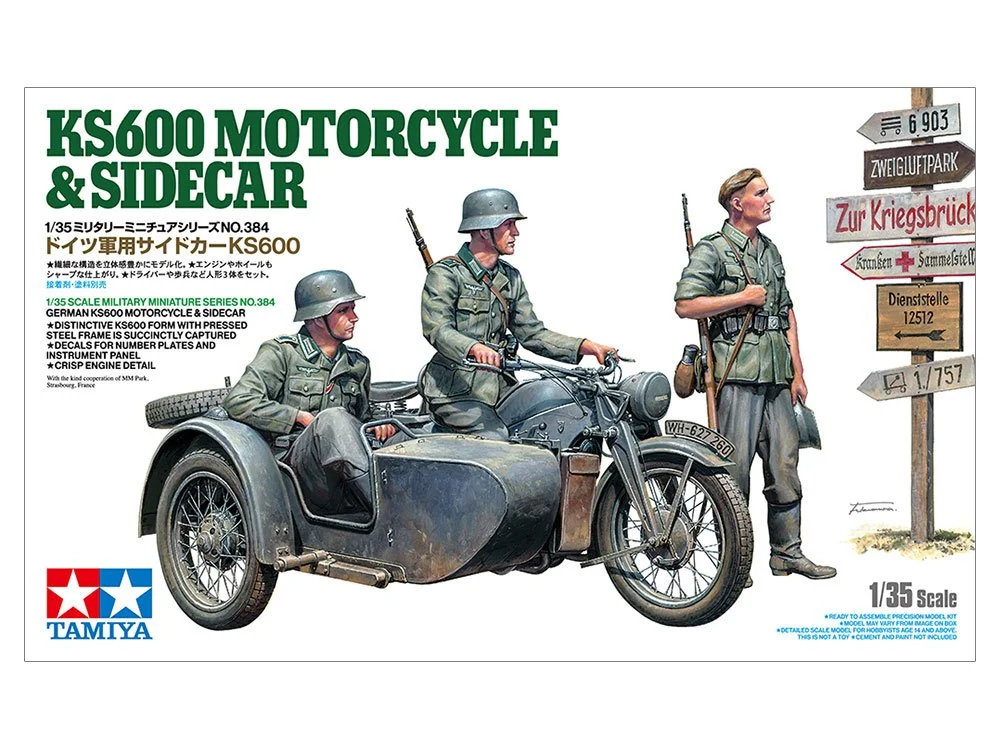
Perhaps the most famous of the 600cc class bikes deployed by the German military in WWII, the KS600 was built around a 28hp horizontally opposed engine with shaft drive. With a sidecar attached, it could reach up to 96km/h and thanks to its 15-liter fuel tank had a range of 300km. Production began in 1938, and it was used in dispatch and reconnaissance roles from the early stages of WWII; although production ceased in 1941, the remaining KS600s stayed in service until the second half of the conflict.
About the Model
This is a 1/35 scale plastic model assembly kit. Length: 71mm, width: 47mm. ★The distinctive form with pressed steel frame is succinctly captured. ★Comes with an NCO figure for the side car, a rider and a standing soldier - a total of 3 figures. ★Road signs are printed on the packaging side and can be cut out to display with your model.
The Pz.Kpfw.I was the first mass-manufactured tank produced by Germany since the post-WWI armor restrictions imposed by the Treaty of Versailles. The initial 1934 Ausf.A variant was followed in 1936 by the upgraded Ausf.B, which saw engine power increased from 57hp to 100hp, as well as a chassis that was some 40 centimeters longer. It was armed with a pair of MG13 machine guns, fired by the commander. Although originally intended only for training use, the Pz.Kpfw.I in fact saw action in the Spanish Civil War from 1936, and then in the German invasions of Poland (1939), France (1940) and the Balkans (1941), and even the ill-fated invasion of the Soviet Union in 1941.
About the Model
★This is a 1/48 scale plastic model assembly kit. Length: 123mm, width: 60mm. The compact form is captured in style based on extensive research of the actual tank. ★Slide molded upper hull and turret feature fine detailing. ★The track beam is recreated accurately. ★Assembly type tracks have one-piece straight sections. ★The model comes with a torso figure and a choice of head sections (beret or side cap). ★3 marking options are included (for units in Poland, France and on the Eastern Front).
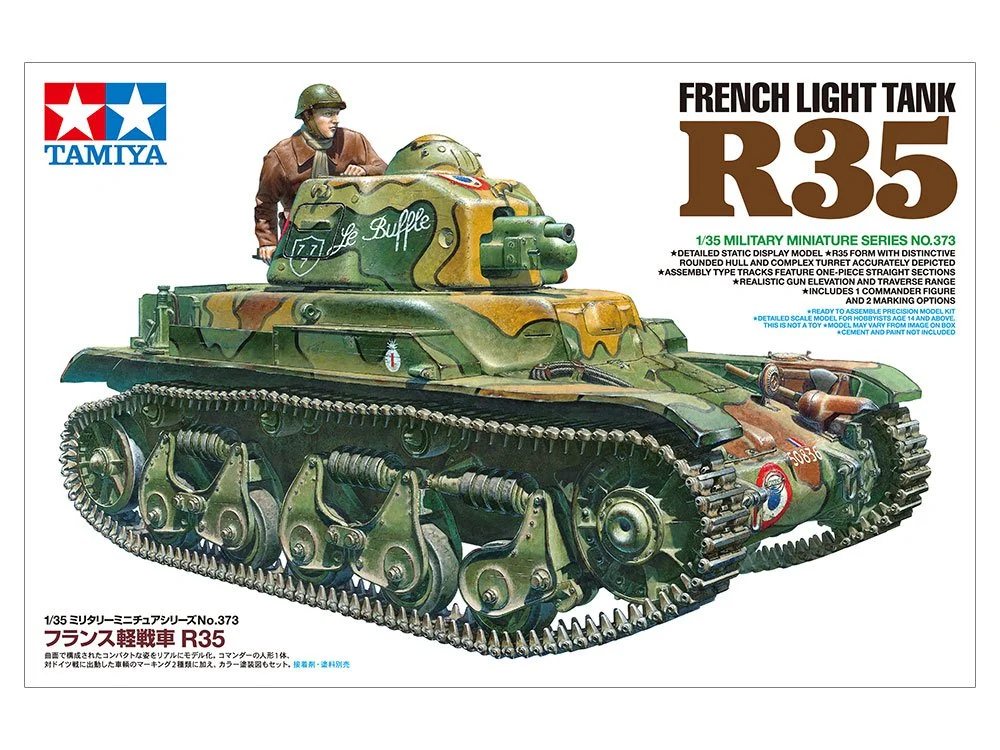
A Doughty Light Tank
By the 1930s French military planners could no longer ignore the obsolescence of their masterpiece FT17 tank from late WWI, and work started on a genuine successor to fill the void. One of the answers they came up with was the R35 light tank, which utilized rolled steel lower and three-piece cast upper hull designs and was armed with the short barreled 37mm gun. It was crewed by two. When hostilities with Nazi Germany burst into life in May 1940 the R35 was right in the front line. While it showed its armor was reliable, the 37mm gun was inadequate when it came to taking out German armor. The Fall of France in June 1940 meant that production of the R35 was curtailed to approximately 1,600 units.
About the Model
★This is a 1/35 scale plastic model assembly kit. Length: 114mm, width: 55mm. ★The R35 form with distinctive rounded hull and complex turret is accurately depicted. ★Turret utilizes slide molding for superior authenticity and a fulfiling build. ★Realistic gun elevation and traverse ranges add to the realism. ★Assembly type tracks feature one-piece straight sections for realistic depiction of upper run 'sag.' ★A single commander figure is included for installation upon the turret rear hatch. ★Comes with two early WWII marking options.
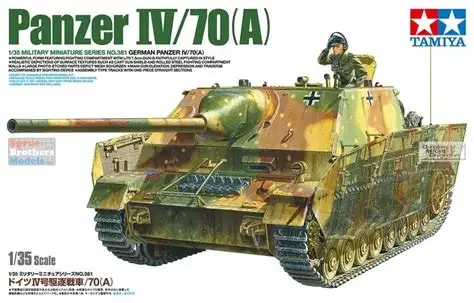
In 1944, the end of WWII, the German Army tried to improve fire power of the German Tank Panzerkampfwagen, and the German Panzer IV/70(A) developed based on this plan. To shorten its development cycle as much as possible, the hull was based upon the German Tank Panzerkampfwagen IV Ausf. J, which was under production at that moment, combined with the fixed fighting compartment with L/70 7.5cm long barrel gun of the IV/70(V) Lang. The Panzer IV/70(A) also featured stiff wire mesh panels called Thoma Schürzen. Around 280 produced in total and it saw service in both Eastern and Western Fronts.
Tamiya has faithfully captured the German Panzer IV/70(A) in every detail! It comes in 1/35 scale and is sure to attract military history aficionados and modelers alike around the world!
• 1/35 scale plastic model assembly kit. Length: 242mm, width: 98mm.
• The German Panzer IV/70(A) form accurately depicted based on extensive research at the Saumur Armored Museum in France.
• The hull is based upon the German Tank Panzerkampfwagen IV Ausf.J kit (35181) with new slide molding on sides, and late production fuel port hatch and return roller support frame recreated in detail.
• Aside from drive sprockets, road wheels and return rollers, other components are all new.
• Main gun moves - elevation/depression and traverse - accompanied by sighting device.
• Features opening commander and loader hatches.
• Features realistic depictions of surface sections such as cast gun shield and rolled steel fighting compartment walls.
• Assembly type depictions of lightweight tracks have one-piece straight sections.
• Large photo-etched parts authentically capture mesh Schürzen.
• Includes one torso commander figure.
• Comes with a choice of two marking options to recreate versions at the Eastern and Western Front.
• Use separately sold 1/35 German Jagdpanzer IV /70 (V) Lang Metal Gun Barrel Set (12660) to add even more detail.
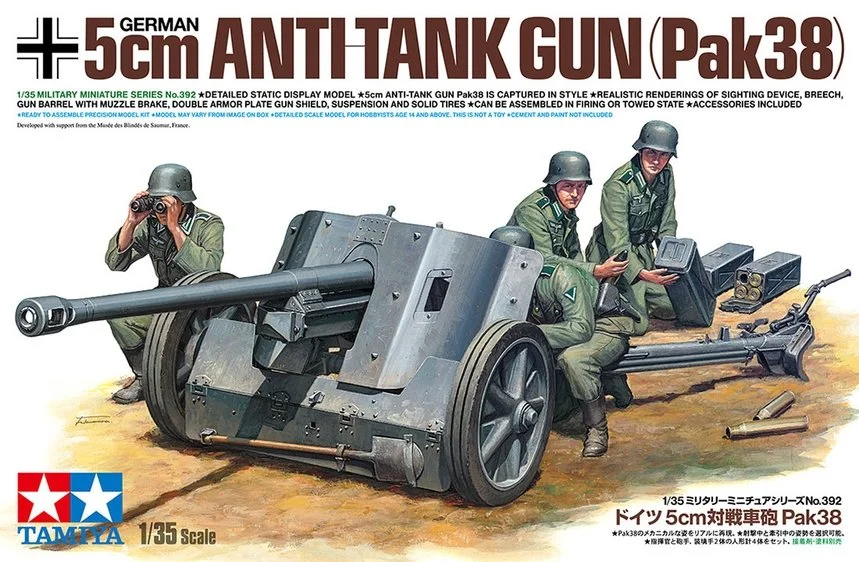
Tamiya German Anti-Tank gun model kits include Item 35035 (1/35 German 3.7cm Anti-Tank Gun Pak35/36), Item 35047 (1/35 German 7.5cm Anti-Tank Gun Pak40/L46) and Item 35017 (1/35 German 88mm Gun Flak 36/37) This new model offering into the series depicts the German Anti-Tank Gun Pak38 in 1/35 scale.
At the start of WWII, German forces used 3.7cm Pak36 as their main anti-tank gun. The 5cm anti-tank gun Pak38 was developed as the Pak36’s successor and the actual deployment started in July 1940. The Pak38 featured a gun barrel with muzzle brake, a gun mount with torsion bar suspension and aluminum-alloy trail legs, and its gun shield was composed of two 4mm thick armor plates at a 25mm interval. This anti-tank gun had the power to pierce 60-degree, 61 mm-thick armor from 500 meters using Panzergranate 39 shells. Pak38 saw its first action in the Balkan Theater and Operation Barbarossa in 1941. Although the Pak38 could not easily beat the Soviet T34 and KV-1, it helped the army through crisis several times and was essential at the North African Front. About 9,600 units were produced until 1943 and were employed in Infantry Regiments until the end of war.
• 1/35 scale plastic model assembly kit. Length: 142mm.
• Features realistic renderings of sighting device, breech, gun barrel with muzzle brake, double armor plate gun shield, suspension and solid tires.
• The model can be assembled in a firing or towed state.
• Use Item 35020 (1/35 German Hanomag Sd.Kfz. 251/1) together to recreate the towed state.
• Includes accessories such as armor piercing and howitzer rounds, ammunition cases and four figures to recreate a commander, gunner and two crew.
No results found
No results match your search. Try removing a few filters.